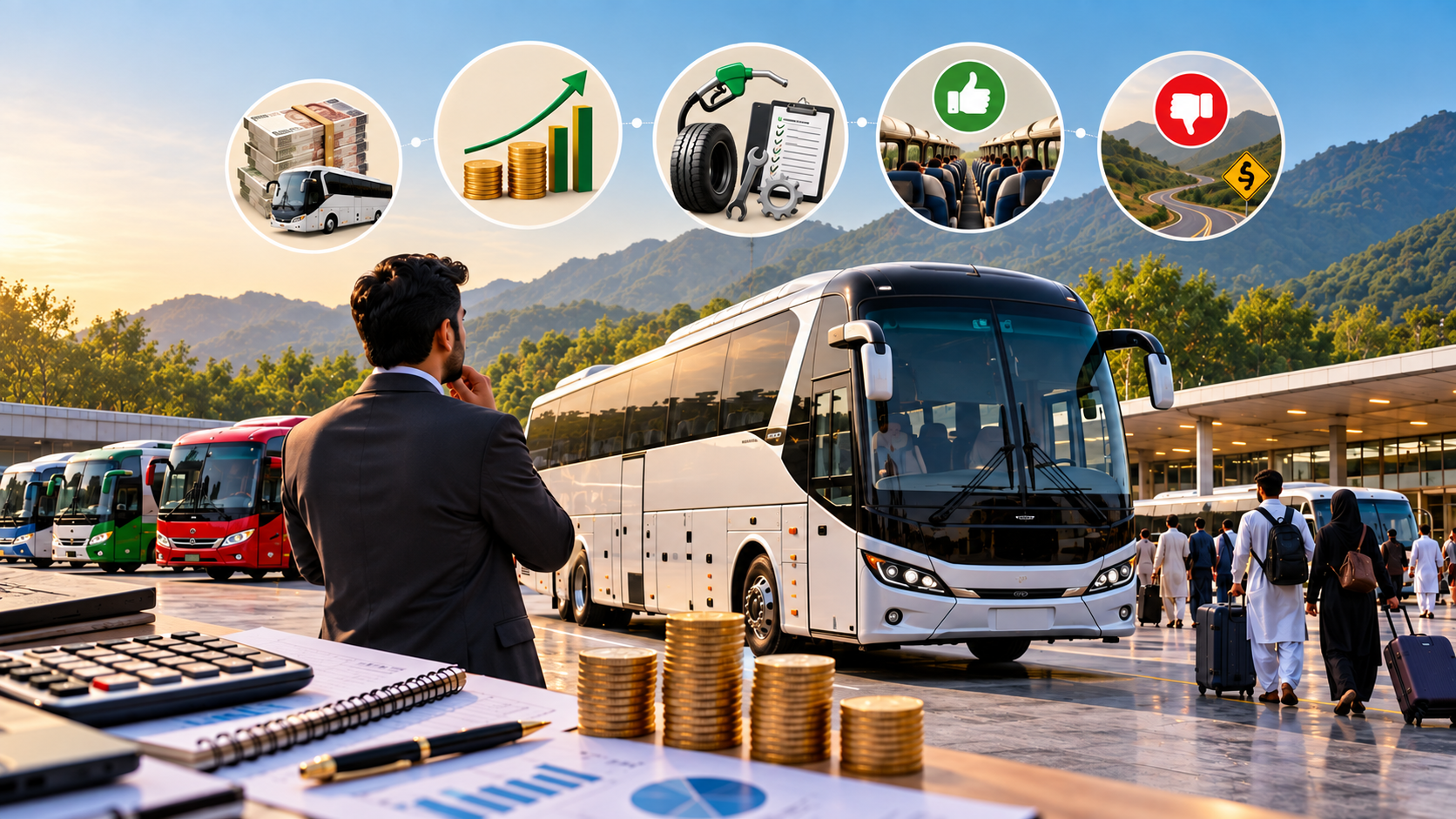

The bus business in Pakistan can look highly profitable from the outside. A bus leaves Lahore with 40 passengers, each passenger pays thousands of rupees for a ticket, and another group pays for the return journey. When you calculate the total ticket revenue, the numbers can look impressive.
But ticket sales are only one side of this business.
A bus owner has to pay for diesel, drivers, motorway tolls, maintenance, tyres, terminals, permits, insurance and other operating expenses. Empty seats can also reduce earnings considerably.
This means the real question is not simply how much revenue a bus generates.
You need to know how much it costs to operate the bus and how much profit remains after paying all expenses.
If you are considering starting a transport business, this guide explains the economics of running a bus in Pakistan, including startup investment, operating costs, potential revenue, profitability, advantages and major risks.
How Does a Bus Business Work in Pakistan?
The basic business model is straightforward.
You purchase or finance a bus, obtain the required permits, choose a route and sell tickets to passengers travelling between different cities.
For example, you could operate a 45-seat coach between Lahore and Islamabad. Revenue would come from passengers travelling from Lahore to Islamabad and another group travelling back to Lahore.
However, you should never build your business plan around 100% occupancy.
A better calculation is:
Number of seats × average occupancy × average ticket price × number of trips
Suppose your bus has 45 seats but normally carries around 32 passengers.
Your financial calculations should use approximately 32 passengers instead of assuming that all 45 seats will be sold every time.
This is important because occupancy can determine whether a route generates a healthy profit or struggles to cover its operating expenses.
How Much Does It Cost to Start a Bus Business in Pakistan?
The bus itself will normally be your largest initial investment.
Bus prices in Pakistan vary considerably according to the manufacturer, model, age, seating capacity, condition and features.
A modern luxury intercity coach can require an investment running into tens of millions of rupees, while purchasing an older used bus can reduce the initial cost.
But the purchase price should not be your entire investment budget.
Suppose you have Rs. 30 million available and spend almost all of it purchasing a bus.
You could immediately face a cash-flow problem because you still need money for:
- Diesel
- Driver and staff salaries
- Motorway tolls
- Maintenance
- Tyres
- Insurance
- Route permits
- Terminal expenses
- Unexpected repairs
You should therefore calculate both the bus purchase price and the working capital required to operate it for several months.
A bus sitting at the terminal because you cannot afford an unexpected repair is not generating revenue.
Major Costs of Running a Bus in Pakistan
Understanding operating costs is one of the most important parts of determining bus business profit in Pakistan.
1. Diesel
Fuel is usually one of the largest expenses.
An intercity bus can travel hundreds of kilometres every day. When this distance is multiplied across an entire month, even a small difference in fuel consumption becomes significant.
For example, a Lahore-Islamabad return operation can involve roughly 700-800 kilometres of travelling, depending on the route and terminal locations.
The amount of diesel consumed will depend on the bus, engine, passenger load, driving conditions and driver behaviour.
Fuel monitoring is therefore extremely important.
A transport company should know exactly:
How many kilometres does each bus travel per litre of diesel?
Without this information, calculating the real cost per trip becomes difficult.
2. Driver and Staff Salaries
You also need people to operate the business.
Depending on the size of your transport company, you may need:
- Drivers
- Backup drivers
- Conductors or hostesses
- Booking staff
- Terminal employees
- Cleaners
- Mechanics
- Operations managers
A single-bus owner may personally handle several responsibilities.
However, once the business grows to five, ten or twenty buses, you will need a proper management system.
3. Motorway Tolls
Motorway tolls are another major cost for intercity operators.
A bus travelling between cities such as Lahore and Islamabad may pay thousands of rupees in toll charges during each journey.
Multiply that by two for a return journey and then by 20-30 trips every month.
The monthly amount can quickly become substantial.
Tolls should therefore always be included when calculating the profitability of a route.
4. Bus Maintenance
Commercial buses cover far more kilometres than ordinary vehicles.
Regular expenses can include:
- Engine oil
- Filters
- Brake components
- Suspension parts
- Air-conditioning repairs
- Electrical repairs
- Engine work
- Transmission repairs
- General servicing
Do not calculate maintenance only when something breaks.
Instead, allocate a certain amount from every trip to a maintenance reserve.
If you do this consistently, a major repair becomes a planned business expense rather than a financial emergency.
5. Bus Tyres
Large commercial tyres are another expense that new investors can underestimate.
A bus requires several tyres, and all of them eventually need replacement.
Instead of considering tyre replacement as a one-time expense, calculate its cost according to expected tyre life.
For example:
Total tyre replacement cost ÷ expected kilometres = tyre cost per kilometre
You can then include this amount in your operating-cost calculation.
6. Terminal and Booking Costs
Passengers need convenient locations to board and leave the bus.
A professional intercity bus company may therefore have expenses for:
- Terminal rent
- Electricity
- Security
- Cleaning
- Booking counters
- Employees
- Waiting areas
- Software
- Online payment processing
Online booking can make ticket purchasing easier, but digital systems also have development, maintenance or commission costs.
7. Permits, Fitness Certificates and Insurance
Commercial passenger vehicles have regulatory requirements.
Depending on your province and operation, these can include route permits, fitness requirements, vehicle documentation, insurance and other approvals.
You should investigate these requirements before purchasing the bus.
There is little benefit in purchasing an expensive vehicle and discovering later that operating it on your intended route requires additional approvals or expenses you did not include in your business plan.
How Much Can a Bus Earn in Pakistan?
Consider a simple hypothetical example of a 45-seat bus operating between Lahore and Islamabad.
Suppose:
Factor
Example
Total seats
45
Average occupancy
70%
Average passengers
32
Average ticket price
Rs. 2,600
Route
Lahore-Islamabad-Lahore
Revenue for one side would approximately be:
32 × Rs. 2,600 = Rs. 83,200
For a return operation:
Rs. 83,200 × 2 = Rs. 166,400
The bus therefore generates approximately Rs. 166,400 in ticket revenue.
But this is not your profit.
Example of Bus Business Profit in Pakistan
Suppose the same return operation has the following expenses:
Expense
Illustrative Cost
Diesel
Rs. 100,000
Motorway tolls
Rs. 9,540
Driver/crew allocation
Rs. 10,000
Maintenance and tyre reserve
Rs. 12,000
Terminal/admin/other expenses
Rs. 8,000
Total estimated cost
Rs. 139,540
Estimated operating surplus:
Rs. 166,400 – Rs. 139,540 = Rs. 26,860
This example is only for understanding how the calculation works. Actual fuel consumption, fares, occupancy, salaries and other expenses will vary.
It also does not mean that every Lahore-Islamabad bus generates Rs. 26,860 profit per return operation.
The important lesson is the relationship between occupancy, revenue and operating costs.
Occupancy Can Make or Break the Business
Imagine your bus is already travelling from Lahore to Islamabad.
Whether 25 passengers or 40 passengers are sitting inside, many expenses remain similar.
You still need the driver.
You still need diesel.
You still pay motorway tolls.
The bus still accumulates kilometres and maintenance costs.
This makes an empty seat a lost revenue opportunity.
Suppose the average fare is Rs. 2,600.
If you carry:
20 passengers: Rs. 52,000 revenue
30 passengers: Rs. 78,000 revenue
40 passengers: Rs. 104,000 revenue
Moving from 20 to 40 passengers doubles ticket revenue for that side of the journey without doubling most operating expenses.
This is why successful transport businesses pay close attention to occupancy.
Choosing a Profitable Bus Route in Pakistan
Buying a good bus does not automatically create a successful transport company.
You also need the right route.
Major routes such as:
Lahore-Islamabad
Lahore-Rawalpindi
Lahore-Multan
Lahore-Faisalabad
Islamabad-Peshawar
Lahore-Karachi
can provide substantial passenger demand.
However, high demand also attracts competition.
Before selecting a route, research:
Passenger demand: How many people regularly travel on the route?
Competition: How many established operators already serve it?
Ticket prices: What are passengers currently paying?
Travel time: How many journeys can one bus realistically complete?
Tolls: What motorway and road charges apply?
Terminal access: Where will passengers board?
Peak periods: When is demand strongest?
A route with slightly fewer passengers but limited competition could sometimes make more commercial sense than entering a heavily contested corridor.
How Can a New Bus Company Compete?
Passengers already have established operators to choose from.
A new company therefore needs to give people a reason to switch.
You can compete through:
Clean buses: Passengers notice cleanliness immediately.
Punctual departures: People travelling for work or appointments value reliability.
Comfortable seats: Comfort becomes increasingly important on longer routes.
Professional drivers: Safe and smooth driving can improve customer retention.
Easy online booking: Customers increasingly expect convenient digital ticketing.
Competitive fares: Your price needs to make sense compared with established operators.
Better terminals: Convenient pickup and drop-off locations can influence customer decisions.
Customer service: One poor experience can prevent someone from booking again.
Price should not necessarily be your only competitive advantage.
Building a reputation for safety, cleanliness and punctuality can be more sustainable than constantly trying to offer the cheapest ticket.
Additional Ways a Bus Business Can Make Money
Ticket sales do not have to be your only revenue source.
Cargo and Parcel Delivery
Intercity buses regularly travel between major cities.
Available luggage or cargo capacity can potentially be used for parcel transportation where regulations and operations permit it.
Corporate Transportation
Companies may require regular transportation for employees between offices, factories or cities.
Long-term contracts can provide relatively predictable revenue.
Tourism
Buses can also be used for organised tours, university trips, corporate events and private group travel.
Advertising
Companies may pay to advertise on buses, inside vehicles or at terminals.
These sources may not replace ticket revenue, but they can improve overall fleet economics.
Pros of Starting a Bus Business in Pakistan
Strong Demand for Intercity Travel
Pakistan has a large population and significant movement between cities.
People travel for employment, university, business, healthcare, tourism and family reasons.
This creates recurring demand for transportation.
Regular Cash Flow
Most passengers pay before travelling.
That means the business can generate cash every day instead of waiting weeks or months for customers to pay invoices.
Potential for Expansion
You do not necessarily need to build a large transport company immediately.
You can start with one or a few buses, learn the economics of your route and expand when the numbers support further investment.
Multiple Sources of Revenue
Tickets, parcels, advertising, private bookings, tourism and corporate contracts can create different revenue streams.
The Bus Has Resale Value
A large portion of your initial investment remains attached to a physical asset.
A properly maintained bus can retain resale value, although mileage, age, condition and depreciation will affect its future price.
Cons of Starting a Bus Business in Pakistan
High Startup Cost
Modern intercity coaches can require tens of millions of rupees.
That creates a significant financial barrier for smaller investors.
Diesel Prices Affect Profitability
Fuel represents a major portion of operating costs.
A significant increase in diesel prices can quickly reduce your margins.
Increasing ticket prices may help, but passengers can become more price-sensitive when fares rise.
Expensive Repairs
An engine, transmission or air-conditioning problem can require a substantial amount of money to repair.
If you operate only one bus, a breakdown can also stop your revenue while the vehicle is being repaired.
Strong Competition
Established companies already have fleets, terminals, booking networks and brand recognition.
Entering their strongest routes can therefore be difficult.
Management Problems
Transport businesses can experience financial leakage through:
- Fuel misuse
- Unrecorded passengers
- Cash handling
- Spare-parts theft
- Unnecessary repairs
- Poor route planning
GPS tracking, fuel monitoring, digital ticketing and proper accounting can help reduce these problems.
Accidents and Safety Risks
Passenger transport carries significant responsibility.
Poor vehicle maintenance or unsafe driving can have consequences far greater than financial losses.
Driver training, vehicle fitness, proper rest periods, tyre condition and preventive maintenance should therefore remain priorities.
Can You Start a Bus Business With One Bus?
Yes, but there are advantages and disadvantages.
Starting with one bus allows you to learn the business without immediately investing in a large fleet.
You can understand:
- Actual fuel consumption
- Passenger behaviour
- Profitable departure times
- Maintenance requirements
- Ticket pricing
- Seasonal demand
The disadvantage is reliability.
If your only bus develops a serious mechanical problem, your entire operation can temporarily stop.
With multiple buses, another vehicle may be able to cover the schedule.
For a new investor, starting smaller can still make sense, provided enough working capital is available for unexpected expenses.
Bus Business vs Property Investment in Pakistan
Suppose you have Rs. 30 million.
You could purchase property or invest that money in a bus and transport operation.
These investments work very differently.
Property can potentially appreciate while generating rental income and may require relatively limited daily involvement.
A bus can potentially produce stronger cash flow, but it depreciates as it ages and accumulates kilometres.
It also requires active management.
With a bus, you are therefore buying two things:
A physical asset + an operating business
Your expected return should compensate for depreciation, management time and business risk.
How to Calculate Bus Business Profit Before Investing
Do not buy a bus first and investigate the route afterwards.
Do the calculations first.
Start with:
Average ticket price × realistic passengers per trip × monthly trips
This gives estimated monthly ticket revenue.
Then subtract:
Diesel + motorway tolls + salaries + maintenance + tyres + terminal costs + insurance + permits + booking costs + administration + financing + taxes + depreciation
The remaining amount provides a much better picture of profitability.
You should also calculate different scenarios.
For example:
Occupancy
Scenario
40%
Weak demand
50%
Below-average demand
60%
Moderate demand
70%
Healthy demand
80%
Strong demand
90%
Very strong demand
Do not build your feasibility study around 90-100% occupancy.
If the business only becomes profitable when nearly every seat is occupied, one weak month could create serious cash-flow problems.
Is Bus Business Profitable in Pakistan?
There is no single profit figure that applies to every bus operator.
Profit depends on the route, bus purchase cost, financing, ticket price, occupancy, diesel consumption, tolls, salaries, maintenance and management efficiency.
A well-managed bus operating on a route with strong passenger demand can generate attractive revenue.
However, a poorly selected route, low occupancy, expensive financing or high maintenance costs can quickly reduce that revenue.
This is why investors should focus less on how much money a full bus collects and more on how much profit remains after every kilometre travelled.
The bus business in Pakistan has genuine commercial potential because transportation remains an everyday necessity. But it is also a capital-intensive business where relatively small changes in diesel prices, occupancy and maintenance costs can significantly affect profit.
If you are considering entering this business, research the route before purchasing the vehicle.
Find out how much competitors charge, how many passengers travel at different times, what the return journey looks like, how much diesel the bus consumes and what your total cost per kilometre will be.
Most importantly, calculate your break-even occupancy.
Instead of asking:
“How much can one bus earn in Pakistan?”
Ask:
“How many passengers do I need on every trip before this bus starts making money?”
Once you know that number, you can judge the economics of the bus business far more realistically.